New iPhone 11 Design and screen: must try harder
Spec and battery boosts that add up
Even putting the new features of iOS 13 to one side – dark mode, Find My and revamped privacy controls are a few that stick out – Apple has made tweaks here and there. None turn the iPhone 11 into an entirely different experience to the iPhone XR but nonetheless you might want to pay for them.
There’s an hour extra battery, which doesn’t hurt, and Apple’s claim that the 11 can go for 10 hours of video streaming is on par with what we’ve seen in our testing. There’s no 18W fast charger in the box (unlike with the Pros) and we haven’t been able to test out whether it can go from nought to 80 per cent in 30 minutes yet. But if you want to buy one, it costs £29.
Throw the iPhone 11 Pro and Pro Max into the mix and the 11 Pro only offers one more hour of regular use over the iPhone 11, a neat example of how narrow the gap between this £729 phone and the £1,000+ phone really is.
Apple also says this is now the “toughest glass in a smartphone”, down to it being strengthened via a dual ion-exchange. We dropped our iPhone 11 a couple of times and it survived unsmashed – only time will tell if iPhones can realistically go without cases long term.
It’s easy to forget that the audio performance of the iPhone, with good headphones, is excellent. Apple has put more effort into spatial audio this year, with Dolby Atmos support which now seems to be something of a standard across phones. Of course that relies on the quality of what you’re watching or listening to – we still think the stereo speakers lend themselves to music and podcasts more than movies and games, though.
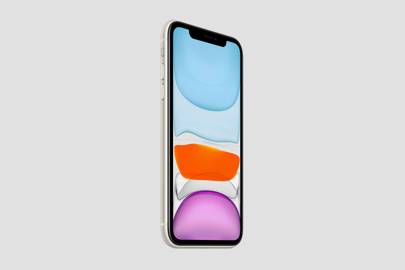
The new colours for the glossy back, including pastel green and purple, are fun but the sleek profile is long gone with a double bump on the back to accommodate the new camera setup. One ding is that the overall design does now look outdated next to the latest Android phones, due to the slightly large notch and fairly noticeable bezels, in a way that perhaps it didn’t last year.
It’s still well made and ergonomic but it’s tricky to see a way back to the clean lines with the focus so heavily on camera hardware. For the first time, part of an iPhone looks a bit ugly and that can’t be good for Apple’s street cred.
The 6.1-inch LCD display is still terrific. Side-by-side you’ll notice that the fancy OLEDs on the 11 Pro will go brighter or produce deeper blacks for those arthouse movies or photo editing you’re planning to do. But we don’t think it’s a problem that Apple has kept this screen tech one of the few points of difference between the real flagships and this very, very good go-to iPhone.
It seems a bit lax to have this display stuck on 326ppi, though. This has been the threshold for Apple’s Retina displays for aeons now and we’d certainly like to see a higher resolution next time around. The 11 Pro, by comparison, is a pin-sharp 458ppi on its smaller 5.8-inch screen. Perhaps after the success of the iPhone XR, Apple went all-in on this spec.